


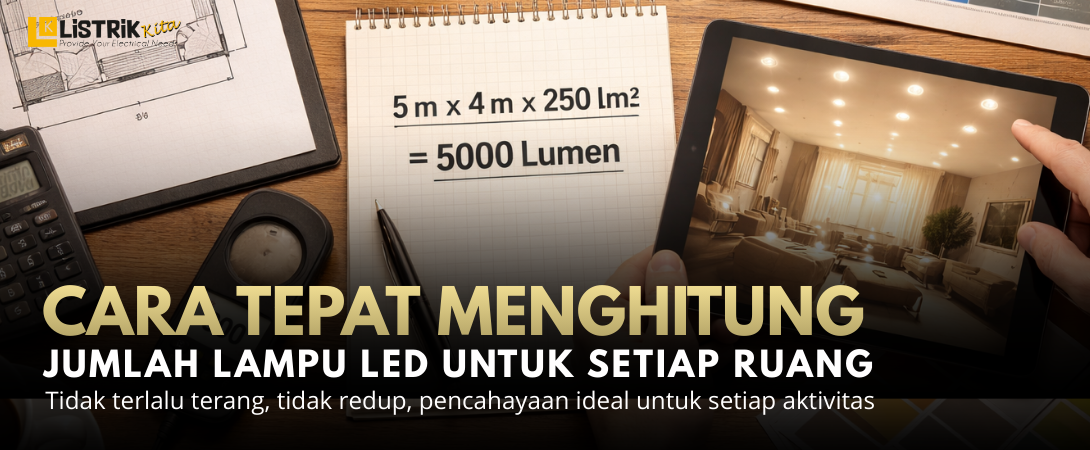
Optimal lighting is the heart of a comfortable and functional home. In an era where LED lights are the top choice for their energy efficiency and long lifespan, many people still struggle to figure out the right number and type of lights. Common mistakes like a room being too dark or overly harsh can be easily avoided with a simple calculation. This guide will walk you through each step to accurately determine your LED lighting needs. You can then create the perfect lighting for every corner of your home without wasting your budget or energy.
Step 1: Understand the Room's Character and Primary Function
The first and most important step is to understand what the room is used for. Different activities demand different lighting levels. The standard for lighting level is measured in lux, which means the amount of lumens (light output) per square meter.
Standard Light Intensity Based on Room Type
A living room, as a relaxation area, generally needs 100 to 200 lux. Meanwhile, a kitchen, where detailed tasks like food preparation happen, requires brighter light, around 200-300 lux. A bedroom can be in the range of 100-150 lux for its main light, but a reading area next to the bed needs an additional light source with an intensity of 300-400 lux. For a bathroom, 200-250 lux is ideal, while a home office or workspace requires 300-500 lux to keep eyes focused and prevent fatigue.
Specific Factors to Consider
Several elements can affect lighting needs. Increase the total lumen calculation by 20-30% to account for high ceilings. If your walls are painted a dark color, add 10-20%. Similarly, a ceiling height exceeding 2.8 meters or the presence of large, dark furniture can reduce light reflection. Also consider the room's occupants; children studying or elderly individuals typically need brighter lighting for comfort and safety.
Step 2: Measure the Room Area Accurately
Accurate calculation starts with precise measurement of the room's dimensions. The room's area is the basis for multiplying the predetermined lux standard.
A Simple Measurement Method
You only need a measuring tape. Measure the room's length from wall to wall in meters, then do the same for the room's width. Multiply these two numbers. The formula is simple: Area (m²) = Length (m) x Width (m). For example, a bedroom with a length of 4 meters and a width of 3.5 meters has an area of 14 square meters.
Step 3: Calculate the Total Lumen Requirement (Light Output)
Once you know the room's function (lux) and its area (m²), it's time to calculate the total "light" needed, measured in lumens.
The Key Formula for Lighting Needs
Total Lumens Required = Room Area (m²) x Required Lux.
Let's take an example. A kitchen measuring 3 meters by 4 meters (12 m²) needs 250 lux of lighting. The calculation is: 12 m² x 250 lux = 3,000 lumens. This means all light sources in that kitchen must produce a total minimum of 3,000 lumens.
Adjustments for Special Conditions
If your room has a very high ceiling or a dominant dark color, the result above needs correction. Adjust the lumen requirement, for high ceilings add 20–30%. If your walls are a dark color, add an additional 10-20%. Applying this to the kitchen, dark green walls mean we increase the 3,000-lumen target by 20%, resulting in a new total of 3,600 lumens.
Step 4: Choose the Right LED Light Products
With the total lumen figure in hand, you can choose LED lights. Modern LED packaging always states the lumen value, not just the wattage (power consumption), making comparison easy.
Conversion: From Lumens to LED Watts
LED lights are very energy efficient. As a reference, a 5-6 watt LED bulb typically produces around 400-500 lumens, equivalent to a 40-watt incandescent bulb. A 9-10 watt LED (800-900 lumens) equals a 60-watt incandescent, and a 13-15 watt LED (1300-1400 lumens) equals a 100-watt incandescent. So, to meet the needs of our example kitchen (3,600 lumens), we could use a combination, for instance: 3 downlight LEDs of 12 watts each (~1200 lumens each) = 3,600 lumens.
Tips for Lighting Distribution
It's better to use several scattered light points than one very bright central light. This approach softens shadows and distributes light more uniformly. Combine a main ceiling light with wall lamps, task lamps, or spotlights for specific areas like a kitchen sink or study desk.
Step 5: Determine the Color Temperature that Creates the Ideal Ambiance
LED lights come in various "light moods" or color temperatures, measured in Kelvin (K). This choice greatly affects the psychology and function of a room.
Understanding the Color Temperature Range
Warm White (2700K-3000K): Produces a soft, calming yellowish light. Perfect for relaxation areas like living rooms and bedrooms, creating a warm and intimate atmosphere.
Cool White (4000K-4500K): Provides a clean, clear white light, similar to morning light. Ideal for kitchens, bathrooms, garages, and home offices, where alertness and precision are needed.
Daylight (5000K-6500K): Has a very bright bluish-white tone, resembling noon sunlight. Good for detailed workspaces, workshops, or sewing areas that require color accuracy and high concentration.
Smart Combinations for Maximum Results
In an open space, you can blend two color temperatures. For example, use cool white light in the kitchen area and warm white in the adjoining dining area. Always consider the color of existing interior elements; wood and earth tones suit warm light, while marble and modern monochrome colors suit cool light.
Applying these five systematic steps will lead you to home lighting that is not only energy efficient but also significantly improves daily comfort, aesthetics, and functionality. Proper lighting is an investment for a better quality of living.
Confused about choosing the right LED light with the correct specs and color temperature for your needs? Don't worry. Visit Listrik Kita today! We provide a wide selection of high-quality LED lights from trusted brands, with clear specifications and competitive prices.
