


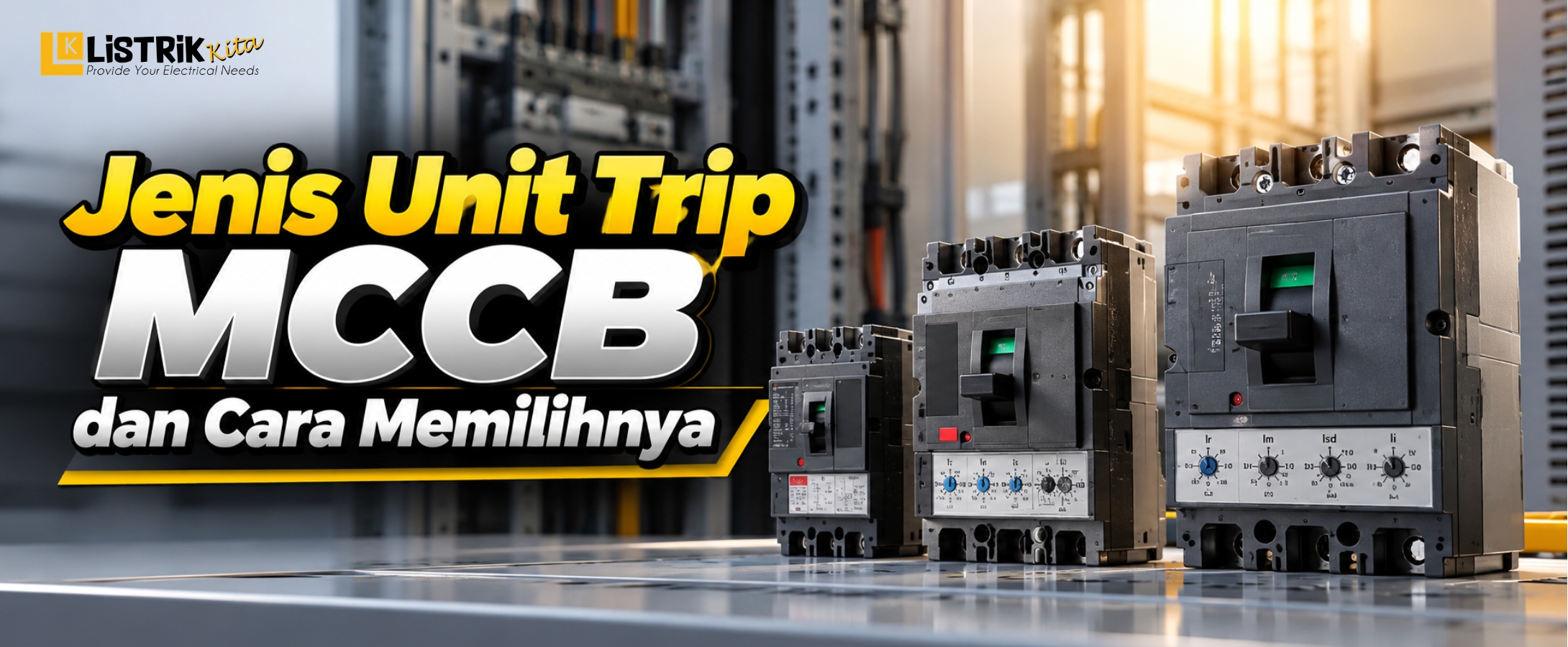
When choosing a circuit breaker, it is important to look beyond the current rating or physical size. One of the key specifications to consider is the trip unit, as it detects abnormal electrical conditions and determines when the circuit breaker needs to interrupt the current. Listrik Kita is an official Schneider Electric distributor that provides original and warranty-backed products, including a wide range of MCCBs for different electrical applications.
The trip unit is one of the factors that determines the protection characteristics of an MCCB. In addition to the trip unit, you also need to consider the ampere rating or In, breaking capacity, and number of phases. Understanding these specifications makes it easier to choose an MCCB that matches the requirements of your electrical system.
1. Types of Trip Units: TMD and Micrologic
MCCBs are available with different types of trip units, including TMD and Micrologic. Both are designed to protect electrical systems from faults, but they use different technologies and offer different adjustment capabilities.
TMD (Thermal Magnetic Trip)
TMD is a trip unit that uses both thermal and magnetic protection. The thermal part detects overload conditions. When the current remains above the allowed level for a certain period, the thermal mechanism operates and trips the circuit breaker.
The magnetic part responds to short-circuit currents that are much higher and occur very quickly. This combination makes TMD a practical option for applications that do not require complex protection settings.
Micrologic
Unlike TMD, Micrologic is an electronic trip unit that uses electronic technology to monitor current and circuit conditions. Depending on the model and application, it can provide more flexible protection settings.
Micrologic is suitable for electrical systems that require more detailed protection control. Certain protection parameters can be adjusted to better match the characteristics of the load and the electrical system.
2. Ampere Rating (In)
Besides the trip unit, the ampere rating or In is another important specification when selecting an MCCB. In is the rated current associated with the circuit breaker's ability to carry current under specified operating conditions.
What Is the Ampere Rating (In)?
Simply put, In can be used as a reference when determining the current capacity of an MCCB. An MCCB with a specific rating is selected based on the load current and the characteristics of the electrical installation.
However, the rating should not be selected based only on the load current. Cable capacity, load type, installation conditions, and the overall protection system should also be considered.
How to Choose the Right Ampere Rating
The MCCB rating should match the requirements of the electrical installation. If the rating is too low, the circuit breaker may trip more often during normal operation. On the other hand, using a rating that is too high without proper calculation may reduce the effectiveness of protection for the load and cables.
For this reason, make sure the MCCB ampere rating matches the electrical design and the load requirements.
3. Breaking Capacity
Breaking capacity is another important specification when selecting an MCCB. It refers to the circuit breaker's ability to interrupt fault current, especially during a short circuit.
What Is Breaking Capacity?
Breaking capacity indicates the maximum short-circuit current that a circuit breaker can safely interrupt under specified conditions. It is generally expressed in kA.
The higher the potential short-circuit current in an electrical system, the more important it is to select an MCCB with a suitable breaking capacity. If the circuit breaker cannot handle the possible fault current, the protection system may not operate safely.
Icu and Ics in MCCBs
MCCB specifications may include the terms Icu and Ics. Icu, or ultimate short-circuit breaking capacity, indicates the maximum short-circuit current that the circuit breaker can interrupt under specified test conditions.
Ics, or service short-circuit breaking capacity, refers to the circuit breaker's ability to interrupt a fault current and remain suitable for service according to the applicable test conditions. Both values are therefore important when comparing MCCBs.
How to Choose the Right Breaking Capacity
Breaking capacity should be selected based on the electrical system and the prospective short-circuit current at the installation point. This helps ensure that the MCCB has sufficient interrupting capability for potential faults.
4. Number of Phases
The number of phases should also match the electrical system being used. MCCBs are available in different pole configurations to meet various installation requirements.
Single-Phase Circuit Breaker
Single-phase systems are commonly used in applications with relatively simple electrical requirements. The number of poles should still be selected according to the conductor configuration and protection requirements.
Two-Pole Circuit Breaker
A 2-pole configuration can be used in certain systems where two conductors need to be disconnected at the same time. Its application should match the electrical system and installation design.
Three-Phase Circuit Breaker
Three-phase systems are widely used in commercial buildings, industrial facilities, and applications with larger electrical loads. For these systems, an MCCB with the appropriate configuration can provide protection for the three-phase circuit.
How to Choose the Right Number of Phases
Before selecting an MCCB, make sure the number of phases and poles match the electrical system. You should also consider the load characteristics and the required disconnection method.
Factors to Consider Before Choosing an MCCB
Choosing an MCCB is not simply about looking at the price or ampere rating. Several specifications need to be considered together, including the trip unit type, In rating, breaking capacity, and number of phases.
For applications that require simpler protection, TMD can be a practical option. Meanwhile, Micrologic can be considered for systems that require more flexible protection settings and monitoring. The ampere rating should match the load and electrical system, while the breaking capacity should be selected based on the potential short-circuit current.
By considering all of these parameters, you can choose an MCCB that is better suited to your electrical system.
If you are looking for Schneider Electric MCCBs for residential, commercial, industrial, or project applications, Listrik Kita provides a range of original and warranty-backed Schneider Electric MCCBs. Find the right product for your electrical system and purchase your Schneider Electric MCCB through ListrikKita.com.
