


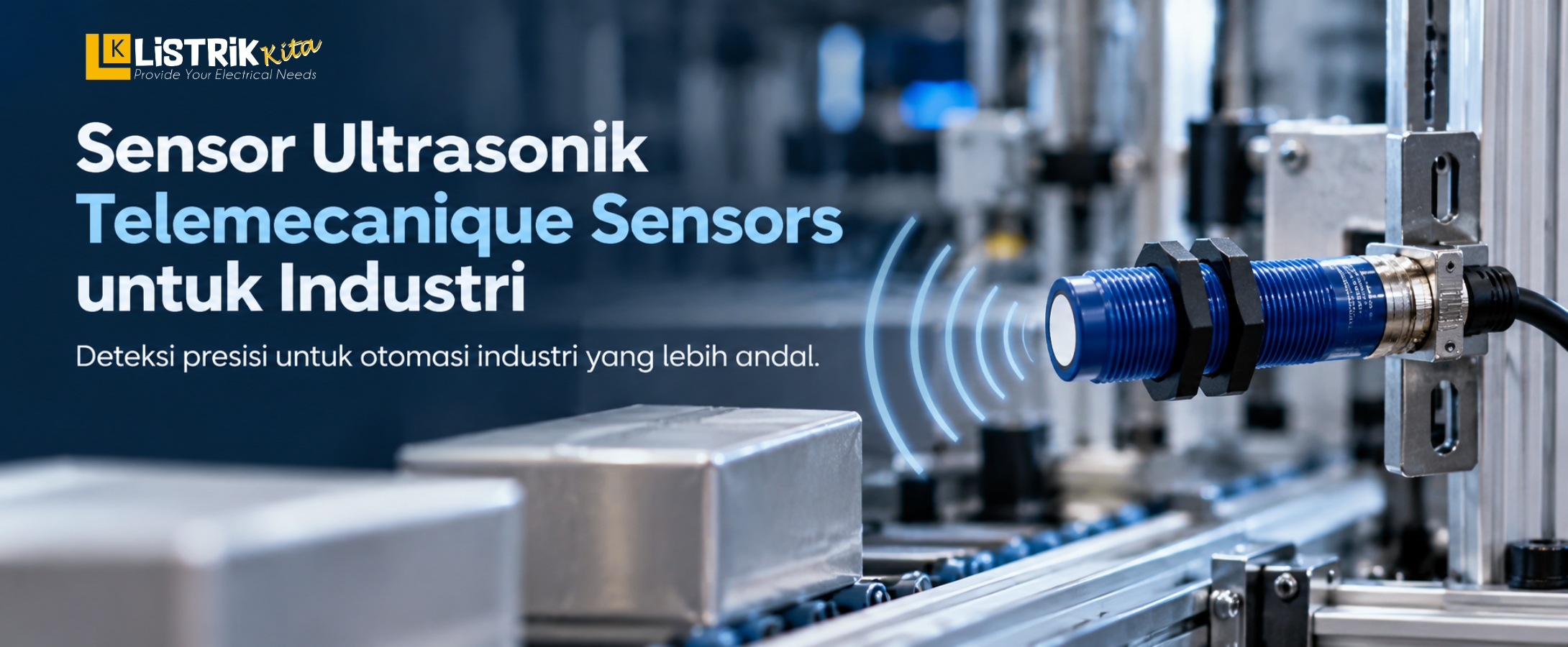
In industrial automation, detecting objects quickly and accurately is important to keep production processes running smoothly. One technology commonly used for this purpose is the ultrasonic sensor. Listrik Kita is an official Telemecanique Sensors distributor that provides original and guaranteed products, including sensor solutions for industrial automation applications.
What Is an Ultrasonic Sensor?
Definition of an Ultrasonic Sensor
An ultrasonic sensor is a device that uses high-frequency sound waves to detect the presence of an object or measure the distance between the sensor and a target. Unlike sensors that require direct contact with an object, an ultrasonic sensor can detect a target without touching it.
The sensor works by sending ultrasonic waves toward an object. When the waves reach the target surface, part of the signal is reflected back to the sensor. The reflected signal is then processed to determine the presence or position of the object.
Because it can detect objects without physical contact, an ultrasonic sensor is a practical solution for many automation applications, especially when objects need to be detected continuously while moving.
Why Are Ultrasonic Sensors Used in Industry?
Ultrasonic sensors offer flexibility for different detection requirements. They can be used with various object shapes and can help detect targets that may be difficult to handle using contact-based detection methods.
They can also be used for applications such as object detection, distance measurement, position checking, and material level monitoring. This makes ultrasonic sensors useful in production machines, conveyors, packaging systems, and other industrial automation applications.
Main Components of an Ultrasonic Sensor
Ultrasonic Transmitter
The transmitter generates and sends ultrasonic waves toward the target. The waves travel through the air until they reach the surface of the object.
Ultrasonic Receiver
When the ultrasonic waves hit an object, part of the signal is reflected back toward the sensor. The receiver captures this reflected signal so it can be processed and used to identify the target.
Processing Unit
The received signal must be processed before it can provide a detection result. The processing unit analyzes the signal to determine information such as the presence or distance of an object.
Housing and Interface
The housing protects the internal components of the sensor, while the interface connects the sensor to the control system. Both parts are important for proper installation and integration into an automation system.
How Does an Ultrasonic Sensor Work?
The Sensor Sends Ultrasonic Waves
The process starts when the sensor sends ultrasonic sound waves toward the area being monitored. These waves have a frequency higher than the range that humans can normally hear.
The Waves Reflect from the Object
When the ultrasonic waves reach an object, they are reflected back toward the sensor. The reflected signal can be affected by factors such as the object's position, size, and surface.
The Sensor Receives the Reflected Waves
The receiver captures the waves returning from the target. The signal is then processed by the electronic system inside the sensor.
Determining Object Presence or Distance
By analyzing the time it takes for the waves to travel to the target and return to the sensor, the system can determine the distance to the object. This information can then be used by the control system to perform the next operation.
Functions and Applications of Ultrasonic Sensors
Object Presence Detection
One of the most common uses of an ultrasonic sensor is detecting whether an object is present in a specific area. This function can be used in automated machines and conveyor systems.
Distance Measurement
Ultrasonic sensors can also measure the distance between the sensor and a target. This information can be useful for monitoring and controlling automated processes.
Material Level Detection
In certain applications, ultrasonic sensors can monitor the level of materials or liquids inside a tank. The detected level can then be used to provide information or trigger an automated control process.
Object Detection on Conveyor Systems
On conveyor systems, ultrasonic sensors can detect products as they pass a specific point. The detection result can support counting, positioning, sorting, and other production processes.
Industrial Automation Applications
With their non-contact detection capability, ultrasonic sensors can be used in many applications, including packaging, material handling, production machines, and industrial automation systems.
Telemecanique Sensors Ultrasonic Sensor
Telemecanique Sensors offers ultrasonic sensor solutions designed to support detection requirements across different industrial applications.
Key Benefits of Telemecanique Sensors Ultrasonic Sensors
High Immunity to Electromagnetic Interference
One of the key benefits is high immunity to electromagnetic interference. This capability helps the sensor operate in industrial environments where electrical and electronic equipment may generate electromagnetic disturbances.
Detection of Small Targets and Curved Surfaces
The sensor also supports detection of small targets and curved surfaces. This provides greater flexibility when detecting objects that are relatively small or have non-flat surfaces.
Detection Over a Large Coverage Area
Another advantage is detection over a large coverage area. A wider detection area can provide more flexibility when deciding where to install the sensor based on the requirements of the application.
Ultrasonic XX Software
The Ultrasonic XX Software can support the sensor configuration process and help users adjust the sensor according to their application requirements. Proper configuration can help achieve suitable detection performance based on the target and operating environment.
Tips for Choosing an Ultrasonic Sensor for Industrial Applications
Check the Detection Range
Make sure the sensor's sensing range matches the distance between the sensor and the target. Choosing the right range helps the sensor operate effectively.
Consider the Target Characteristics
The size, shape, and surface of the target should be considered when selecting an ultrasonic sensor. These characteristics can affect detection performance.
Match the Sensor to the Environment
The installation environment is also important. Conditions involving dust, humidity, temperature, or multiple electronic devices may require a sensor that is suitable for the application environment.
Choose a Sensor Compatible with the Control System
Check the sensor's output type and connection to make sure it can be integrated with the control equipment being used, such as a PLC or other automation systems.
An ultrasonic sensor is a useful solution for object detection in industrial automation. By using ultrasonic sound waves, it can detect objects without direct contact and support applications ranging from distance measurement to product detection on conveyor systems.
If you are looking for a Telemecanique Sensors ultrasonic sensor for your industrial application, Listrik Kita provides original and guaranteed products. Explore the available Telemecanique Sensors ultrasonic sensor solutions for your automation needs and purchase them through Listrik Kita.
