


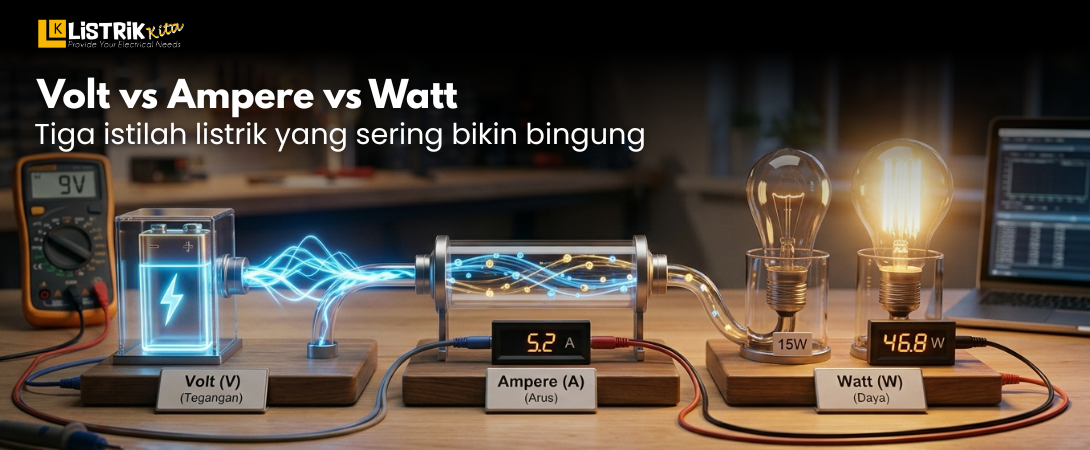
Have you ever been confused when you see “5V/2A” or “20W” written on your phone charger? Or maybe you’ve wondered why a brand new refrigerator bought from overseas suddenly stopped working after you plugged it into your home outlet? Behind those small numbers lie three big concepts in the world of electricity: volts, amps, and watts. People often mix them up, but each one plays a very different role.
To avoid getting them wrong, let’s understand them one by one using a simple approach, like water flowing through a hose. That way, you’ll not only understand electricity better but also stay safer when using electronic devices every day.
Volts: How Strong Is the Electrical Pressure?
Volts are the unit used to measure electrical voltage. In the water analogy, volts act like the water pressure pushing the flow inside a hose. The higher the pressure, the stronger the electrical push that moves the electrons.
In real life, every electronic device has a specific voltage requirement. For example, a small dry battery usually provides 1.5 volts. A car battery operates at 12 volts. Meanwhile, household electricity in Indonesia runs at 220 volts.
A common mistake is ignoring these voltage requirements. If a device is designed for 110 volts and you force it to run on 220 volts, the device can suffer severe damage, even burn out. On the other hand, if the voltage is too low, the device simply won’t turn on at all.
So, voltage is all about compatibility. Before plugging in any device, make sure the power source voltage matches what the device needs.
Amps: How Much Electricity Is Flowing?
Amps measure electric current, or in other words, the number of electrons moving through a circuit every second. Sticking with the water analogy, amps are like the volume of water flowing through the hose. It could be a small trickle or a powerful gush.
Every device draws current according to its needs. For instance, an LED light only needs a small amount of current, usually measured in milliamps. A car starter motor, however, requires a huge amount of current, sometimes hundreds of amps, to crank the engine.
Here’s an important point that often gets misunderstood. The amps available from a power source do not force a device to take that much current. If you have a charger that outputs 2 amps but your phone only needs 1 amp, the phone will only draw 1 amp. So, it is perfectly fine to use a charger with a higher current capacity, as long as the voltage matches.
Watts: The Real Power That Determines Speed or Strength
Watts measure power, which is the result of multiplying volts and amps. If volts are the pressure and amps are the flow rate, then watts represent the total energy produced to do work. For example, it shows how fast water can spin a waterwheel.
The formula is simple. Watts equal volts multiplied by amps.
For example, a charger with a specification of 5 volts and 2 amps produces 10 watts of power. A fast charger with 20 volts and 5 amps produces 100 watts.
Watts are the most relevant number in two key areas. The first is charging speed. For smartphones, the higher the wattage of the charger, as long as the device supports it, the faster the battery charges. The second is your electricity bill. For household appliances, the higher the wattage, the more energy they consume, which ultimately affects your monthly costs.
Volts vs Watts: The Difference in Everyday Use
Even though people often treat them as similar, volts and watts have very different roles in practice.
Volts Determine Compatibility
Voltage is the main factor in deciding whether a device can be used with a particular power source. As mentioned earlier, plugging a 110-volt device into a 220-volt outlet is a fatal mistake. Conversely, if the voltage matches, the device will work normally even if the available current is higher than it needs.
Watts Determine Capacity and Speed
Watts measure capability. When it comes to chargers, watts determine how fast or slow the charging process is. When choosing a generator or a voltage stabilizer, we calculate the total wattage of all devices to figure out the required capacity. When it comes to your home electricity, it is the watts that make your meter spin fast or slow.
Summary of the Differences Between Volts, Amps, and Watts
To make it easier to remember, here is a simple breakdown.
- Volts are electrical pressure. Choose the wrong one, and your device gets damaged.
- Amps are the amount of electrical flow. Devices only take what they need.
- Watts are the total power produced. They determine how fast a device works and how high your electricity bill will be.
In practice, understanding these three units helps us choose the right charger, avoid the risk of short circuits, and save on daily electricity usage.
Safety Tips for Using Electrical Devices at Home
There are a few simple steps you can take to stay safer and more efficient. First, always check the voltage label on your device before plugging it into an outlet. Make sure it matches your home’s electrical voltage. Second, pay attention to the total wattage when using a power strip. Do not let the combined wattage exceed the maximum capacity of the cord or the strip. Third, use quality equipment for your electrical needs, including cables, outlets, and chargers. Non standard equipment can become a safety hazard.
Now that you understand the differences between volts, amps, and watts, it is time to make sure all your electrical needs at home are met with the right and safe equipment. Do not let the knowledge you have gained go unaccompanied by the use of quality devices.
You can find a variety of electrical needs, from cables and outlets to chargers and safety devices, at Listrik Kita. With the right equipment, your home becomes safer, and you can go about your daily activities with greater peace of mind. Visit Listrik Kita now and complete your electrical needs all in one place.
