


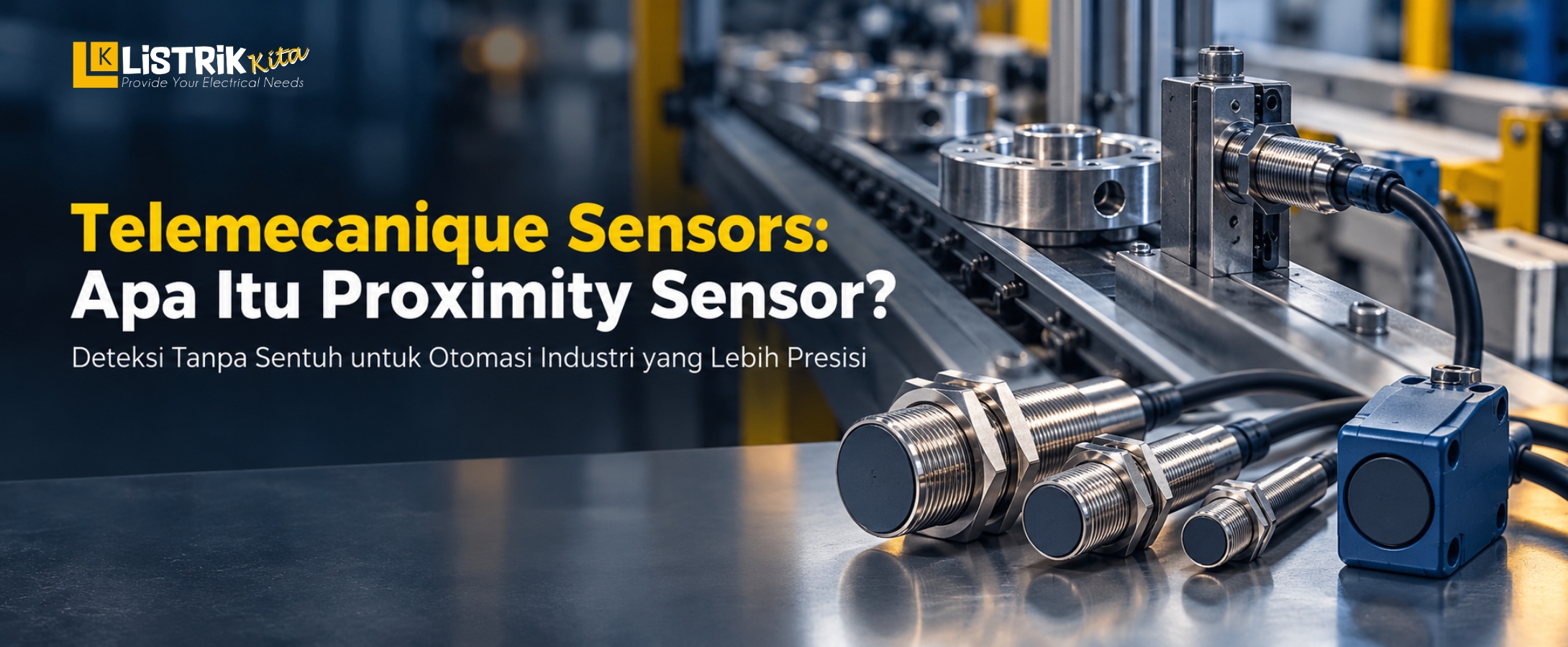
Industrial production requires systems that can work quickly, accurately, and consistently. One of the components commonly used to support these requirements is a proximity sensor. Listrik Kita is an official distributor of Telemecanique Sensors, providing original and guaranteed products, including various sensor solutions for industrial automation needs.
1. What Is a Proximity Sensor?
A proximity sensor is a device used to detect the presence, position, or movement of an object without making direct physical contact with it. This technology makes proximity sensors useful in production machines, conveyor systems, packaging equipment, industrial robots, and other automation applications.
The working principle of a proximity sensor depends on the technology used. Some sensors use electromagnetic fields, changes in capacitance, light, or sound waves to determine whether an object is within the sensing area.
One of the main advantages of a proximity sensor is its ability to detect objects without physical contact. This can help reduce wear caused by friction and support production processes that require fast and repeated detection.
2. Types of Proximity Sensors and How They Work
Each proximity sensor uses a different technology and has its own characteristics. Therefore, the right sensor should be selected based on the object material, sensing distance, environmental conditions, and application requirements.
2.1 Inductive Sensor
An inductive proximity sensor uses an electromagnetic field to detect metal objects. When a metal object enters the sensor's detection area, it changes the electromagnetic field. The sensor then processes this change into an output signal.
Inductive sensors are widely used in manufacturing machines because they can detect metal objects quickly without physical contact. Common applications include detecting the position of machine components, counting metal objects on conveyors, and checking whether a metal part has reached the correct position.
2.2 Capacitive Sensor
Unlike inductive sensors, capacitive sensors can detect a wider range of materials. They work by detecting changes in capacitance when an object enters the sensing area.
Capacitive sensors can detect solid objects as well as materials such as plastic, glass, powders, liquids, and other non-metallic materials. Because of this, they are often used in packaging, material handling, and level detection applications.
2.3 Photoelectric Sensor
A photoelectric sensor uses light to detect the presence of an object. The sensor emits light and monitors changes in the light when an object enters or passes through the detection area.
Photoelectric sensors can detect many types of objects, including objects that may be difficult to detect with inductive sensors. In industrial applications, they are commonly used on conveyors, packaging machines, counting systems, and product sorting processes.
Different detection methods can be used, such as detecting light reflected from an object or using a transmitter and receiver positioned separately. The right method depends on the object, sensing distance, and installation conditions.
2.4 Ultrasonic Sensor
An ultrasonic sensor uses high-frequency sound waves to detect objects. The sensor sends out ultrasonic waves and receives the waves reflected from an object. The time taken for the waves to return can then be used to determine the object's presence or distance.
One advantage of ultrasonic technology is that it does not rely heavily on the object's color or surface condition, unlike some light-based sensing methods. Ultrasonic sensors can be used for distance measurement, product detection on conveyors, and material level monitoring.
3. Wide Applications of Proximity Sensors in Industry
The use of proximity sensors continues to grow as industrial automation develops. These sensors help machines recognize the presence and position of objects, allowing production processes to become more automated.
On production lines, proximity sensors can detect the position of components before the next process begins. In conveyor systems, sensors can help count products and make sure they are in the correct position.
In packaging machines, sensors can detect whether a package is present before filling, sealing, or labeling. In industrial robotics, sensors can also help the system identify the position of an object, allowing handling processes to be performed more accurately.
3.1 Why Are Proximity Sensors Important in Industrial Automation?
Proximity sensors are important components in automation because they can detect objects without physical contact. Using the right sensor can help improve production speed, maintain consistency, and reduce the need for manual inspection.
Proximity sensors can also support many applications, from object detection and counting to positioning and monitoring. With the right sensor selection, an automation system can operate more effectively and support overall industrial productivity.
4. How to Choose the Right Proximity Sensor
Choosing a proximity sensor should not be based only on the sensor type. Several factors should be considered to ensure reliable performance.
4.1 Determine the Material to Be Detected
First, identify the material that needs to be detected. Inductive sensors are generally suitable for metal objects, while capacitive sensors can detect a wider range of materials.
4.2 Consider the Sensing Distance
The distance between the sensor and the target object is another important factor. Make sure the sensor has a sensing distance that matches the application requirements.
4.3 Match the Sensor to the Working Environment
Dust, water, temperature, vibration, and other environmental conditions can affect sensor performance. Choose a sensor with specifications that match the installation environment.
4.4 Consider Detection Speed and Frequency
For high-speed production processes, the sensor needs to respond consistently to moving objects. Make sure its performance matches the speed of the application.
4.5 Choose a Sensor Based on the Automation System
Every application has different requirements. Consider the output type, installation method, sensor size, sensing distance, and compatibility with the control system.
A proximity sensor is an important component in industrial automation systems. It can detect the presence, position, or movement of objects without direct physical contact. The main types include inductive, capacitive, photoelectric, and ultrasonic sensors, each with different characteristics and applications.
Choosing the right sensor can help improve production efficiency, speed, and consistency. If you are looking for Telemecanique Sensors proximity sensors for industrial automation applications, you can find original and guaranteed products at Listrik Kita. Choose the right sensor for your application and get reliable electrical and industrial automation solutions from Listrik Kita.
