


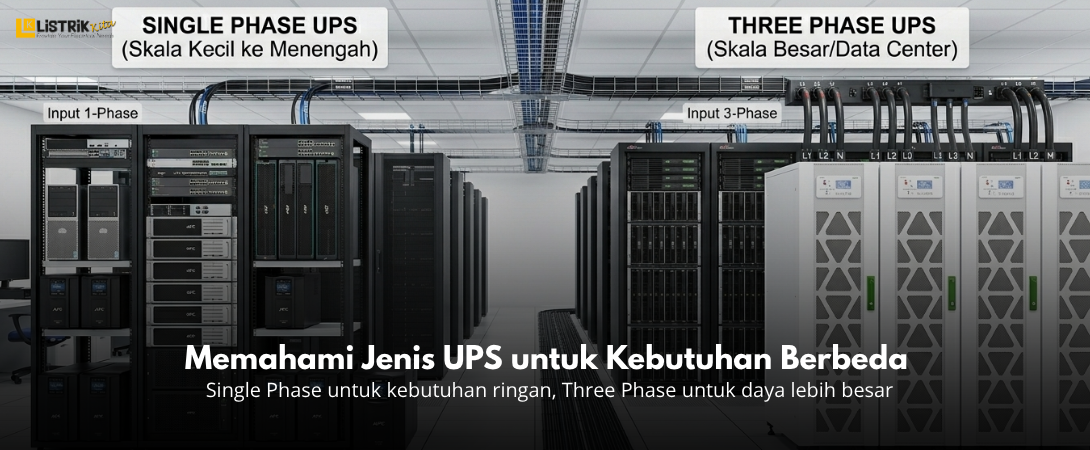
A UPS or Uninterruptible Power Supply is an important device that keeps electrical equipment running during power outages or voltage disturbances. Today, UPS systems are widely used not only for home computers but also for offices, servers, and industrial facilities.
When choosing a UPS, many people are unsure whether they should use a single phase UPS or a three phase UPS. Both systems have the same purpose, but they are designed for different power requirements and applications. Learning the differences can make it easier to select the most suitable solution for your needs.
What Is a Single Phase UPS?
A single phase UPS uses one phase line and one neutral line. This type of UPS is commonly used in homes, small offices, retail stores, and electronic devices with low to medium power requirements.
Single phase UPS systems are easier to install and generally more affordable. They are also available in many different power capacities.
What Is a Three Phase UPS?
A three phase UPS uses three phase lines and one neutral line. This system is designed to handle larger electrical loads with better stability and efficiency.
Three phase UPS systems are commonly used in industries, data centers, hospitals, large buildings, and facilities that require continuous and stable power distribution.
Comparison Table: Single Phase vs Three Phase UPS
Factor | Single Phase UPS | Three Phase UPS |
| Number of Conductors | 1 phase + 1 neutral | 3 phases + 1 neutral |
| Voltage | Usually 220V | Usually 380V to 415V |
| Sinewave Output | Suitable for light loads | More stable for heavy loads |
| Efficiency | Good for small power needs | Better for high power systems |
| Cost | More affordable | More expensive |
| Applications | Homes, PCs, small offices | Industries, servers, data centers |
| Maintenance | Easier maintenance | Requires skilled technicians |
Differences Between Single Phase and Three Phase UPS
Number of Conductors
The main difference is the electrical conductor configuration. A single phase UPS uses one phase and one neutral line, while a three phase UPS uses three phase lines.
With three phases, power distribution becomes more balanced and suitable for larger electrical systems.
Sinewave Output
Most modern UPS systems use pure sinewave output to maintain stable power quality. However, three phase UPS systems usually provide more stable output for industrial equipment and high-load machines.
Stable sinewave output is important to protect sensitive electronic devices.
Voltage
Single phase UPS systems normally operate at around 220V. In contrast, three phase UPS systems can handle higher voltages such as 380V or 415V.
Because of this, three phase UPS systems are more suitable for industrial machinery and large-scale electrical systems.
Efficiency
For smaller power requirements, single phase UPS systems are already efficient enough. However, for higher power capacities, three phase UPS systems provide better energy distribution efficiency.
They also help reduce the risk of unbalanced electrical loads.
Cost
Single phase UPS systems are more budget-friendly in terms of purchase and installation costs. Meanwhile, three phase UPS systems are more expensive because of their larger capacity and more complex design.
Maintenance costs for three phase UPS systems are usually higher as well.
Applications
Single phase UPS systems are suitable for computers, CCTV systems, cash registers, routers, and small office equipment.
Meanwhile, three phase UPS systems are commonly used in data centers, factories, hospitals, and server systems that require uninterrupted power.
Maintenance
Single phase UPS systems are easier to maintain because of their simpler structure. Basic inspections can often be done without professional assistance.
On the other hand, three phase UPS systems require more detailed routine maintenance to ensure optimal performance.
Tips for Choosing the Right UPS
Before buying a UPS, make sure you know the total power requirement of the equipment you want to protect. Choosing a UPS with insufficient capacity may lead to overload problems.
You should also consider the type of electronic devices you use. For homes and small offices, a single phase UPS is usually enough. For industrial applications and large electrical loads, a three phase UPS is a better option.
Efficiency, maintenance requirements, and operational costs should also be considered for long-term use.
Both single phase and three phase UPS systems have their own advantages depending on the application. Single phase UPS systems are ideal for lighter power needs and lower budgets, while three phase UPS systems are designed for larger electrical systems that require higher efficiency and stability.
If you are looking for a reliable UPS for your home, office, server, or industrial application, you can find various trusted UPS products at Listrik Kita based on your power requirements.
